
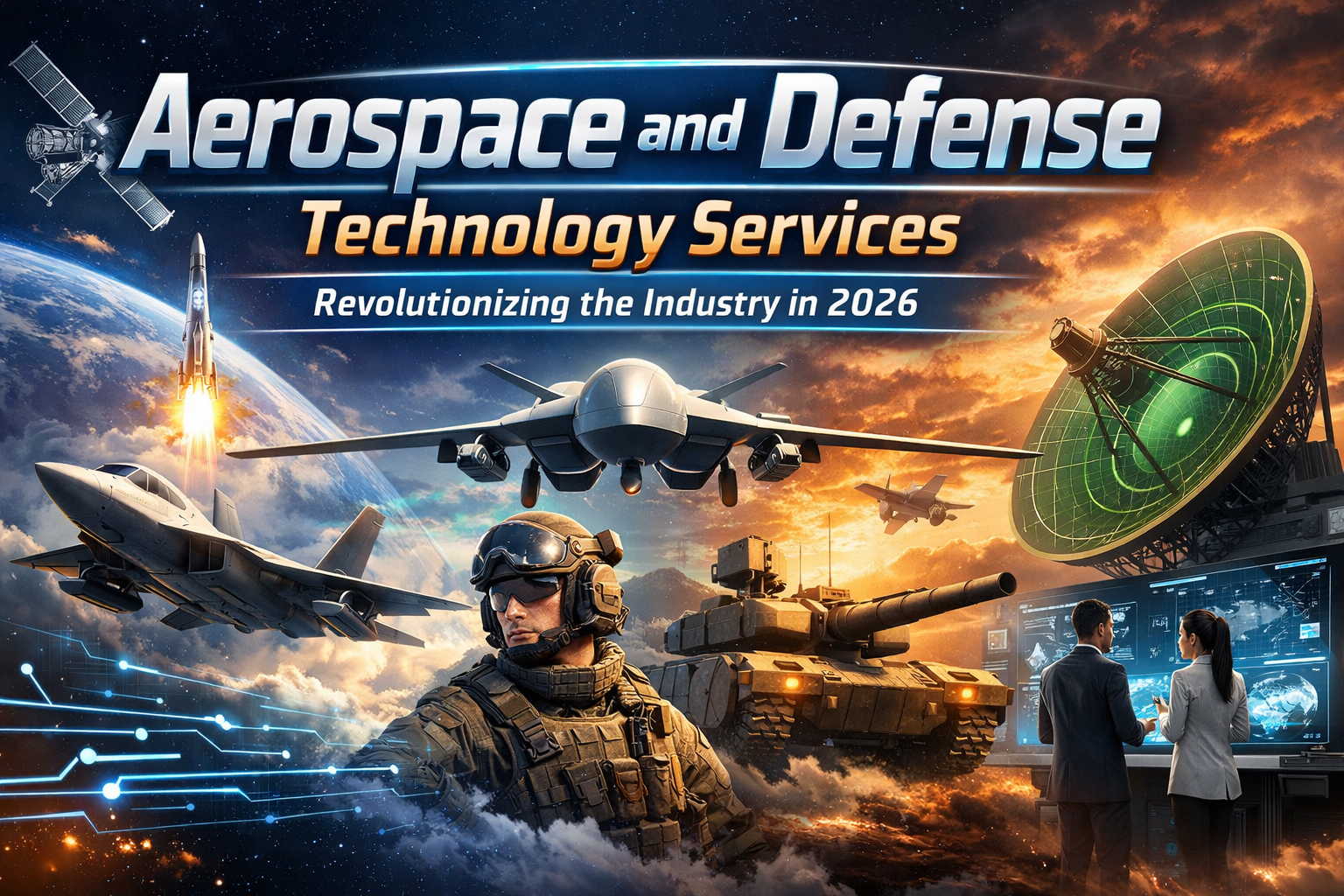
The nature of warfare has changed dramatically. Battlefields are no longer defined only by boots on the ground or warships at sea - they now extend into cyberspace, low-earth orbit, and the electromagnetic spectrum. At the heart of this transformation lies one non-negotiable foundation: aerospace and defense technology services.
Nations that invest strategically in this domain are not simply upgrading military hardware - they are redefining the future of national security itself.
The Shifting Landscape of Modern Warfare
Global defense budgets are surging at a historic pace. US defense spending alone crossed the $849.8 billion threshold for fiscal 2025, with projections pointing well beyond $1 trillion in the years ahead. European NATO members are rapidly scaling investments in air defense, cyber resilience, and advanced ISR (Intelligence, Surveillance, Reconnaissance) systems.
This surge is not coincidental. Geopolitical tensions, rising asymmetric threats, and the rapid pace of technological disruption have forced militaries worldwide to fundamentally rethink their operational doctrines - and the engineers and technology partners who support them are more critical than ever before.
Why Aerospace and Defense Technology Services Are Non-Negotiable
Modern warfare demands platforms that are smarter, faster, and far more integrated than anything built in the previous century. Aerospace and defense technology services serve as the backbone of this evolution - connecting research, engineering, systems integration, and sustainment into a unified operational lifecycle.
Here is why these services have become absolutely mission-critical:
1. Autonomous Systems and Drone Warfare
Unmanned systems have evolved from reconnaissance assets into frontline combat platforms. Swarming drones, loitering munitions, and AI-powered UAVs are now central to next-generation warfare strategies. This shift toward autonomous combat platforms demands deep aerospace engineering services to design, test, certify, and sustain these systems at operational scale.
Naval warfare is transforming too. Autonomous surface vessels and underwater drones are reshaping fleet compositions, reducing crew risk while dramatically expanding combat reach.
2. Hypersonic Weapons and Advanced Propulsion
The race for hypersonic dominance is accelerating fast. The US fiscal 2025 budget allocated over $163 million specifically toward hypersonic research and development - covering thermal protection systems, solid rocket motor technologies, and advanced inertial measurement units. Nations that can design, test, and deploy hypersonic platforms first will command a decisive strategic advantage. None of this is achievable without precision aero systems engineering services that bridge concept to deployable capability.
3. AI-Driven Battle Management
Artificial intelligence is no longer a future ambition in defense - it is an operational reality. From predictive maintenance and autonomous target recognition to AI-powered command and control systems, militaries are embedding machine intelligence at every tier of the operational stack.
US aerospace and defense spending on AI is forecast to reach $5.8 billion by 2029 - more than 3.5 times the 2025 baseline. Engineering teams are currently building the architecture to make this acceleration safe, reliable, and deployable under real battlefield conditions.
4. Electronic Warfare and Cyber Dominance
The electromagnetic spectrum has become as strategically contested as any physical terrain. Modern electronic warfare systems leverage AI and machine learning to automatically detect, analyze, and counter hostile signals with remarkable precision. The global electronic warfare market alone is projected to reach $23 billion by 2030.
Simultaneously, cyber threats targeting defense networks, satellite systems, and critical supply chains demand sophisticated cybersecurity frameworks built directly into platform design from day one - not added as an afterthought after deployment.
5. Space as a Warfighting Domain
Space situational awareness, resilient satellite communications, and space-based command infrastructure have elevated orbit into a primary warfighting domain. Aerospace engineering solutions are actively evolving to address satellite constellation resilience, debris management, and the seamless integration of space-based assets with ground, air, and naval forces.
The Engineering Foundation Behind Every Capability
What separates a defense concept from a fielded capability is engineering execution. Aerospace engineering solutions span the full program lifecycle - from structural analysis, propulsion design, and avionics integration to digital twin modeling, simulation environments, and rapid prototyping.
Additive manufacturing is creating new pathways for producing complex components faster and at significantly lower cost. Digital transformation tools are enabling predictive maintenance across aging fleets, reducing unplanned downtime and extending operational life. These are not incremental improvements - they are mission-critical capabilities that determine operational success or failure.
The Partnership and Talent Imperative
None of this engineering progress happens without the right people and the right strategic partnerships. Defense organizations increasingly rely on agile, specialized firms that bring multidisciplinary expertise - combining software development, systems engineering, cybersecurity, and materials science under one roof.
Supply chain resilience has also emerged as a hard strategic priority. A single weak link - whether in solid rocket motor supply, advanced microelectronics, or composite materials sourcing - can delay an entire defense program by years, with serious consequences for national readiness.
Conclusion
The battlefield of tomorrow is being shaped today - by the investments, decisions, and engineering partnerships that governments and defense agencies are making right now. Investing in the right technical capabilities is not optional; it is the price of maintaining strategic relevance in an increasingly contested world.
At DANSOB, we understand that the demands of future warfare require far more than hardware - they require precision engineering, integrated systems thinking, and an unwavering commitment to mission-ready solutions that perform when it matters most.
The future belongs to those who are already building it.


Write a comment ...